
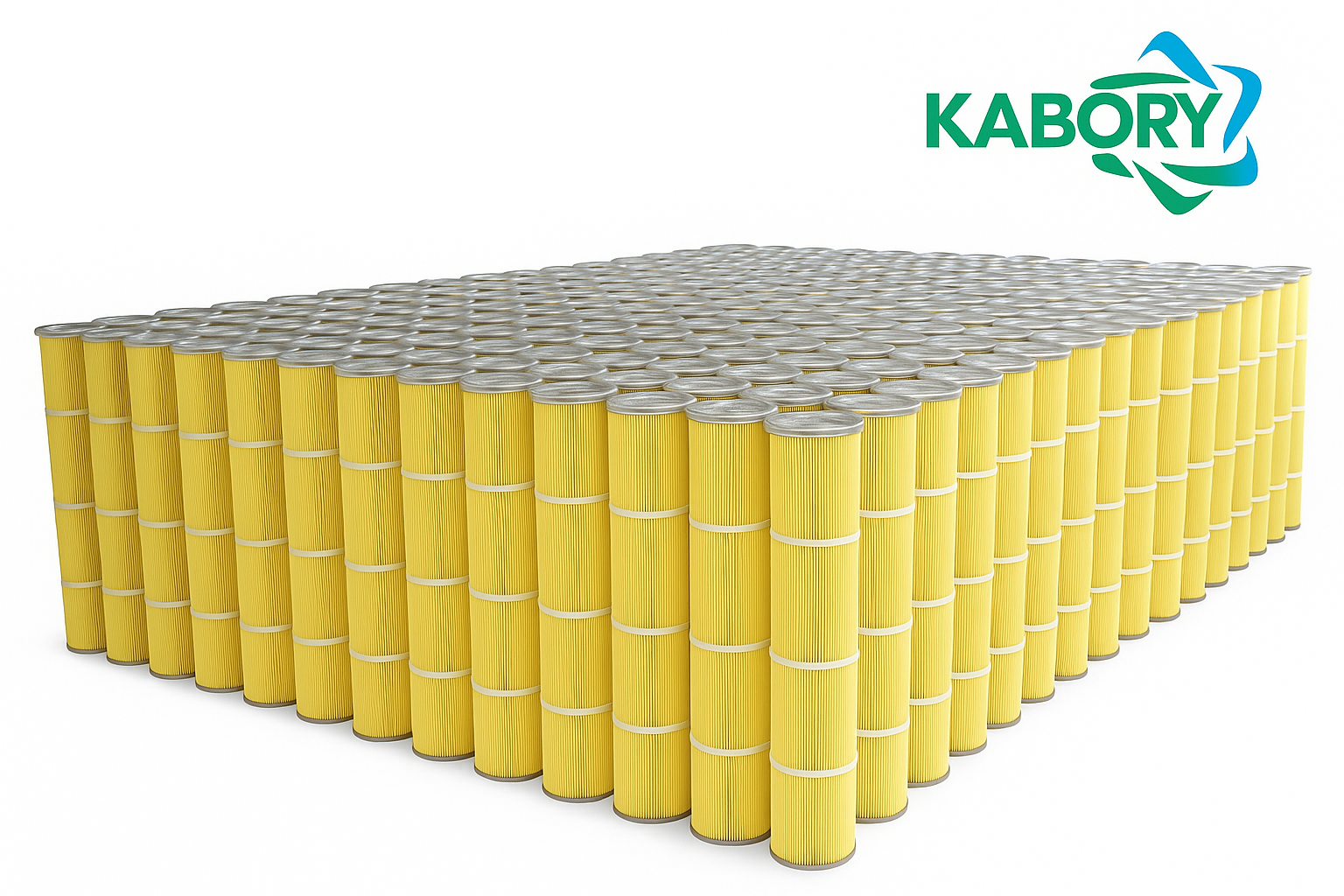
Spunbonded Polyester Pleated Filter Media
Spunbonded polyester filter media engineered for pleated filter cartridges, offering high mechanical strength, stable filtration efficiency, and flexible surface treatments for industrial dust collection applications.
Description
Spunbonded Polyester Media for Pleated Filter Cartridges (Dust Collector Cartridges)
Specifically Engineered for Industrial Dust Collector Cartridges
Product Overview
Our spunbonded polyester filter media is engineered specifically for pleated filter cartridges used in industrial dust collection systems, delivering a balanced combination of mechanical strength, filtration precision, abrasion resistance, and long-term operational stability.
This media is widely applied in demanding dust collection environments such as powder coating, metal grinding, cement processing, woodworking, and pharmaceutical manufacturing, where filter media must withstand continuous pulse-jet cleaning, high dust loading, and fluctuating operating conditions.
With uniform pore distribution, high tensile strength, and excellent pleat stability, spunbonded polyester media provides reliable performance over long service cycles while helping reduce maintenance frequency and overall operating cost.
Why Spunbonded Polyester Is Preferred for Pleated Filter Cartridges
Structural Stability and Cleanability in Industrial Operation
In pleated filter cartridge applications, media structure is as critical as filtration efficiency.
Compared with other commonly used media types, spunbonded polyester offers a clear structural advantage.
- Unlike cellulose media, which is cost-effective but mechanically weaker and moisture-sensitive, spunbonded polyester maintains pleat geometry under repeated pulse-jet cleaning and abrasive dust exposure.
- Compared with nanofiber-coated media, spunbonded polyester provides a stronger mechanical base layer, ensuring long-term pleat stability and resistance to abrasion. Nanofiber layers, when required, are typically applied on a spunbonded polyester substrate rather than used alone.
For this reason, spunbonded polyester is widely selected as the base media for industrial cartridge filters operating under continuous and demanding conditions.
Performance Characteristics of Spunbonded Polyester Media
Mechanical Strength and Filtration Balance
Spunbonded polyester media delivers a balanced filtration profile suitable for most industrial dust collection systems:
- Effective filtration precision in the 0.3–5 μm range
- Stable pressure drop behavior over extended service intervals
- Excellent resistance to abrasion from dust and cleaning cycles
- Reliable performance in humid or fluctuating environments
This balance makes it particularly suitable for applications where long service life and predictable maintenance cycles are more important than extreme fine-particle capture alone.
Technical Specifications of Spunbonded Polyester Media
Base Material Properties
| Item | Specification |
|---|---|
| Material | 100% Polyester |
| Basis Weight | 260 g/m² |
| Thickness | 0.55 mm |
| Air Permeability | 150 L/m²·s |
| Filtration Precision | 0.3–5 μm |
| MERV Rating | MERV 11–16 |
| Tensile Strength (Warp) | 380 N / 5 cm |
| Tensile Strength (Weft) | 440 N / 5 cm |
| Continuous Temperature Resistance | ≤135 °C |
Surface Treatment Options and Application Selection
Adapting Spunbonded Polyester Media to Different Operating Conditions
While spunbonded polyester performs well as a standalone media, surface treatments allow further optimization for specific dust characteristics and regulatory requirements.
| Surface Treatment | Function & Application Benefit |
|---|---|
| PTFE Membrane | Enhances fine dust capture and stabilizes filtration efficiency |
| Anti-Static (Aluminum or Carbon) | Reduces electrostatic buildup in explosive dust environments |
| Water & Oil Repellent | Improves cleanability in humid or oily dust conditions |
| Flame Retardant | Enhances safety in applications involving elevated temperatures |
| Nanofiber Coating | Improves surface filtration for fine and ultra-fine particles |
In practice, nanofiber coatings are most effective when combined with a spunbonded polyester base, preserving mechanical durability while improving fine-particle capture.
Engineering Selection Perspective: Media Type Comparison
From an engineering standpoint, media selection is not about choosing the most advanced option, but the most appropriate one.
- Cellulose media is generally selected for light dust loads and cost-sensitive applications, but its moisture sensitivity and limited mechanical strength restrict its use in harsh industrial environments.
- Nanofiber-coated media is chosen when emission limits are strict and fine dust control is critical, though its performance depends heavily on the stability of the underlying base media.
- Spunbonded polyester media occupies the balanced middle ground, offering durability, cleanability, and predictable lifecycle cost, making it the preferred choice for most industrial pleated filter cartridges.
Typical Applications of Spunbonded Polyester Pleated Filter Media
- Industrial cartridge dust collectors
- Powder coating and surface finishing systems
- Metal grinding and machining operations
- Cement and mineral processing plants
- Pharmaceutical and fine powder handling
- Woodworking and general industrial dust collection
Remarks & Testing Conditions
- Air permeability is measured at ΔP = 200 Pa.
- Filtration precision refers to the initial particle capture performance before dust cake formation. In actual operation, filtration efficiency can be enhanced by optimizing air-to-cloth ratio and establishing a stable dust cake.
- MERV ratings are tested according to ASHRAE 52.2 (USA) or EN 779 (Europe) standards.
★ All technical parameters are provided for reference only. Test results may vary depending on test methods and operating conditions. Specifications are subject to change without prior notice.
Spunbonded polyester provides the mechanical foundation for pleated filter cartridges,
while surface treatments and coatings tailor filtration performance to specific dust conditions.