
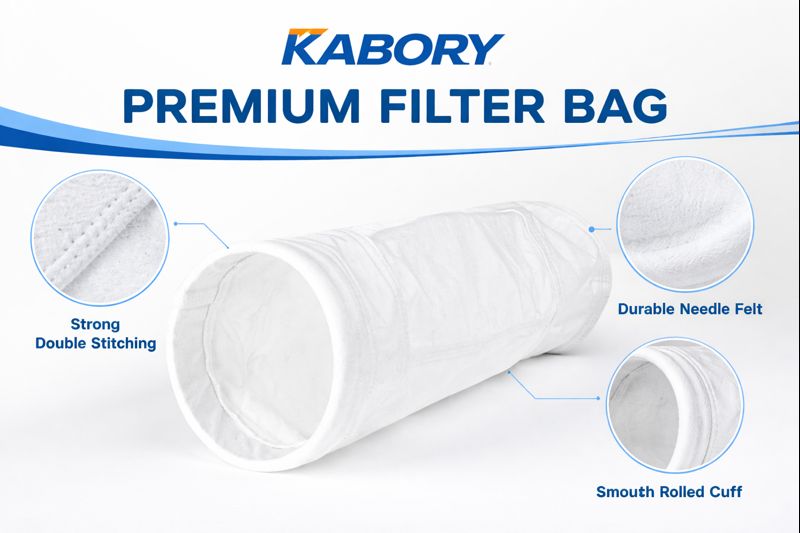
100% Virgin PTFE Needle Felt for High-Temperature Filtration
KABORY supplies high-quality 100% virgin PTFE needle felt engineered for high-temperature, corrosive, and chemically demanding industrial dust filtration.
Manufactured using fine-denier 3D–5D virgin PTFE fibers and a carefully balanced PTFE supporting scrim, our PTFE filter felt provides excellent chemical resistance, thermal stability, dimensional stability, and long-term filtration reliability.
Available as PTFE needle felt rolls or finished PTFE filter bags, with customized weight, width, surface configuration, and optional PTFE membrane.
Description
100% Virgin PTFE Needle Felt
High-Performance Filter Media for Severe Industrial Filtration Conditions
When industrial filtration systems operate under a combination of high temperature, aggressive chemical gases, moisture, and corrosive process conditions, conventional filter media may experience accelerated degradation.
KABORY supplies high-quality 100% virgin PTFE needle felt specifically developed for these demanding industrial filtration environments.
Both the filtration fibers and supporting structure are based on PTFE, allowing the filter media to benefit from the inherent thermal and chemical resistance of the PTFE polymer.
Our PTFE needle felt can be supplied directly in rolls for professional filter bag manufacturers or further converted into customized finished PTFE filter bags.
Why Choose 100% Virgin PTFE Needle Felt?
PTFE is one of the most chemically resistant high-performance polymers used in industrial filtration.
Unlike blended high-temperature felts, our standard PTFE needle felt is manufactured using 100% virgin PTFE fibers, without blending lower-cost high-temperature fibers into the filtration layer.
Key Advantages
- 100% Virgin PTFE Fiber
- Excellent resistance to acids and alkalis
- Excellent resistance to many corrosive industrial gases
- Excellent resistance to moisture and hydrolysis
- Excellent high-temperature stability
- Continuous operating temperature up to approximately 250°C
- Short-term peak temperature up to approximately 280°C
- Good dimensional stability at elevated temperatures
- Excellent resistance to chemical aging
- Suitable for demanding pulse-jet filtration systems
- Fine-denier 3D–5D PTFE fiber construction
- PTFE membrane option available
- Supplied as rolls or finished filter bags
Typical Technical Specifications
| Property | Typical Specification |
|---|---|
| Fiber Material | 100% Virgin PTFE |
| Supporting Scrim | 100% PTFE |
| Filter Media Type | Needle-Punched Felt |
| Typical Weight | 700–900 g/m² |
| Fiber Fineness | 3D–5D |
| Typical Scrim Weight | 120 g/m² |
| Continuous Temperature | Up to approximately 250°C |
| Short-Term Peak Temperature | Up to approximately 280°C |
| Thickness | Customized according to specification |
| Air Permeability | Customized according to application |
| Width | Customized |
| Surface Configuration | Application-Specific |
| Membrane Option | PTFE Membrane |
| Supply Form | Rolls / Finished Filter Bags |
| Customization | Available |
Exact specifications should be defined according to the actual filtration system, operating conditions, and customer requirements.
Typical Industrial Applications
Our 100% virgin PTFE needle felt is designed for demanding industrial dust collection applications involving high temperature, corrosive gases, high moisture, or aggressive chemical conditions.
Typical applications include:
- Waste-to-energy plants
- Municipal waste incineration
- Hazardous waste incineration
- Chemical processing plants
- Petrochemical processing
- Non-ferrous metal smelting
- Lead and copper processing
- Steel and metallurgical processes
- Industrial furnaces and kilns
- High-temperature mineral processing
- Power generation
- Industrial boiler filtration
- Aggressive flue-gas treatment systems
- High-corrosion industrial exhaust filtration
- High-temperature pulse-jet baghouses
- Other severe industrial dust collection applications
PTFE needle felt is particularly valuable where high temperature and chemical corrosion occur simultaneously, and where conventional polyester, aramid, or other filter media may not provide sufficient long-term stability.
Final media selection should always consider actual temperature, gas chemistry, moisture, dust characteristics, filtration velocity, and cleaning conditions.
Designed for Severe Industrial Filtration Environments
PTFE needle felt is generally selected where process reliability is more important than initial material cost.
During continuous operation, filter media may be exposed simultaneously to:
- High operating temperatures
- Strong acidic gases
- Alkaline environments
- High moisture
- Oxidizing gases
- Corrosive process by-products
- Repeated pulse-jet cleaning
- Mechanical stress
- Dust abrasion
- Differential-pressure cycling
- Long continuous operating periods
For these applications, the performance of PTFE needle felt depends not only on the PTFE polymer itself, but also on fiber quality, fiber fineness, web formation, needling consistency, supporting scrim design, and overall material uniformity.
KABORY therefore focuses on controlling the complete filter media structure rather than relying only on the nominal material specification.
Fine-Denier PTFE Fiber Engineering
3D–5D PTFE Fibers for More Uniform Felt Structure
PTFE fibers are inherently more difficult to process than many conventional textile fibers.
Because of their low surface friction and relatively limited fiber-to-fiber cohesion, careful control is required during:
- Fiber opening
- Carding
- Web formation
- Layering
- Needle punching
- Thermal stabilization
KABORY uses fine-denier 3D–5D virgin PTFE fibers to achieve a more uniform fiber architecture.
Compared with coarser PTFE fiber constructions, properly processed finer fibers can help provide:
- More uniform fiber distribution
- Better surface coverage
- Reduced risk of localized density variation
- More consistent felt thickness
- More uniform pore distribution
- Improved integration between fiber layers
- More consistent filtration behavior across the roll
Fine fibers are more demanding to process, making precise carding and web control especially important.
Why Fiber Distribution Matters
A PTFE needle felt may meet its nominal weight specification while still showing significant differences in actual material uniformity.
Poor fiber opening or uneven web formation can lead to:
- Localized thin areas
- Visible supporting scrim
- Uneven fiber density
- Inconsistent permeability
- Localized mechanical weak zones
- Uneven filtration behavior
KABORY focuses on achieving uniform fiber coverage and consistent fiber distribution across the complete roll.
Material consistency becomes particularly important when the felt is later processed into long industrial filter bags and subjected to repeated pulse-jet cleaning.
100% Virgin PTFE Fiber
The quality and consistency of PTFE raw material directly influence the final needle felt structure.
KABORY uses 100% virgin PTFE fiber for our standard high-performance PTFE needle felt.
We do not intentionally blend recycled production offcuts or lower-cost high-temperature fibers into the filtration fiber layer.
This helps maintain:
- Consistent fiber characteristics
- More uniform fiber dispersion
- Cleaner material appearance
- More predictable processing behavior
- Stable filtration performance from batch to batch
For professional filter bag manufacturers, raw-material consistency is especially important because variations in the felt can directly influence downstream cutting, sewing, dimensional accuracy, and finished filter bag performance.
Balanced PTFE Supporting Scrim
120 g/m² PTFE Scrim
The supporting scrim provides mechanical reinforcement and dimensional stability within the needle felt structure.
KABORY typically uses a 120 g/m² PTFE supporting scrim as part of a balanced filter media construction.
Our design philosophy is not to rely solely on a heavier supporting fabric to increase nominal mechanical strength.
Instead, mechanical performance is achieved through the combination of:
- Controlled PTFE fiber distribution
- Proper fiber-to-scrim integration
- Consistent needle-punching density
- Balanced supporting scrim construction
- Uniform overall felt structure
This approach helps maintain flexibility while providing the mechanical support required for demanding industrial baghouse operation.
Standard PTFE Needle Felt
Our standard 100% virgin PTFE needle felt is designed to provide a balance of:
- Chemical resistance
- Thermal stability
- Mechanical durability
- Filtration performance
- Dimensional stability
- Cleaning performance
The final felt construction can be adjusted according to application requirements, including:
- Weight
- Thickness
- Air permeability
- Fiber architecture
- Supporting scrim
- Surface configuration
- Roll width
- Finished filter bag construction
PTFE Membrane Needle Felt
For applications requiring enhanced surface filtration and fine-particle control, KABORY can supply PTFE membrane laminated PTFE needle felt.
The microporous PTFE membrane creates a surface filtration layer that helps capture fine particles before they penetrate deeply into the felt structure.
Potential advantages include:
- Improved fine-particle capture
- Reduced deep dust penetration
- Easier dust cake release
- More stable differential pressure
- Improved cleaning behavior
- Better control of fine particulate emissions
- Reduced interaction between process dust and the supporting felt structure
PTFE membrane filtration is particularly suitable for applications requiring high filtration efficiency and controlled particulate emissions.
Whether a membrane is required should be determined according to actual dust characteristics, emission requirements, filtration velocity, and cleaning system.
Chemical and Moisture Resistance
One of the primary advantages of PTFE filter media is its excellent chemical stability.
PTFE needle felt is suitable for many applications involving:
- Strong acidic gases
- Alkaline environments
- High moisture
- Corrosive process gases
- Aggressive chemical compounds
- Harsh industrial exhaust conditions
Its excellent resistance to hydrolysis makes PTFE particularly valuable where moisture and elevated temperature occur together.
However, correct filter media selection should always be based on the complete gas composition and operating environment, rather than relying only on general material properties.
High Temperature Is Only One Selection Factor
PTFE provides excellent high-temperature capability, but temperature alone does not determine whether PTFE is the most appropriate filter media.
Before selecting PTFE needle felt, the following operating conditions should be evaluated:
- Normal operating temperature
- Maximum operating temperature
- Moisture content
- SO₂ / SO₃ concentration
- HCl and other acid gases
- Alkali exposure
- Oxygen concentration
- Other reactive or corrosive gases
- Dust type
- Dust concentration
- Dust abrasiveness
- Particle size distribution
- Air-to-cloth ratio
- Differential pressure
- Pulse cleaning pressure
- Emission requirements
PTFE is generally selected where chemical resistance, thermal stability, and long-term process reliability justify the higher initial material cost.
PTFE vs. Other Filter Media
Different filter materials are designed for different operating environments.
| Filter Media | Main Advantage | Typical Selection Consideration |
|---|---|---|
| Polyester | Economical general-purpose filtration | Lower-temperature and moderate chemical conditions |
| Meta-Aramid | High-temperature resistance with good mechanical durability | Relatively dry high-temperature filtration |
| PPS | Good chemical and hydrolysis resistance in suitable conditions | Moist and chemically demanding applications |
| Fiberglass | High-temperature capability | Mechanical flexing and abrasion conditions require consideration |
| PTFE | Excellent chemical resistance and high-temperature stability | Severe chemical, moisture, and high-temperature environments |
There is no single filter medium suitable for every industrial process.
Final selection should be based on temperature, moisture, gas chemistry, dust properties, cleaning method, emission requirements, and expected service life.
From PTFE Needle Felt to Finished Filter Bags
KABORY can supply both:
100% Virgin PTFE Needle Felt Rolls
and
Finished PTFE Filter Bags
This gives different types of customers greater sourcing flexibility.
Professional filter bag manufacturers can purchase PTFE needle felt rolls for their own production, while industrial end users, baghouse service companies, and filtration-system manufacturers can order finished filter bags according to their existing specifications.
Finished PTFE filter bags can be customized with:
- Different bag diameters
- Different bag lengths
- Snap-band tops
- Customized cuff constructions
- Reinforced bottoms
- PTFE sewing thread
- Needle-hole sealing
- PTFE membrane
- Customized labeling
- Customized packaging
Why Filter Bag Manufacturers Need Consistent PTFE Felt
PTFE is a premium filtration material, and inconsistency in the needle felt can create problems during downstream filter bag manufacturing.
Variations in:
- Weight
- Thickness
- Air permeability
- Fiber coverage
- Felt density
- Width
- Surface condition
- Dimensional stability
can affect:
- Cutting accuracy
- Sewing stability
- Seam consistency
- Bag diameter
- Bag length
- Snap-band assembly
- Finished filter bag quality
For this reason, KABORY focuses not only on nominal technical specifications but also on consistent roll-to-roll production quality.
Available as Rolls or Finished PTFE Filter Bags
For Filter Bag Manufacturers
PTFE needle felt can be supplied in rolls according to the required:
- Weight
- Width
- Roll length
- Air permeability
- Supporting scrim
- Surface configuration
- PTFE membrane requirement
- Packaging specification
For Industrial End Users
We can also convert PTFE needle felt into finished filter bags according to:
- Existing filter bag drawings
- Existing samples
- Tube-sheet dimensions
- Dust collector specifications
- Existing filter bag construction
- Actual operating conditions
This allows customers to source either the PTFE filter media itself or the complete finished filtration component from KABORY.
Information Required for PTFE Filter Media Selection
For a more accurate PTFE needle felt recommendation, please provide:
- Normal operating temperature
- Maximum operating temperature
- Moisture content
- Gas composition
- SO₂ / SO₃ concentration
- HCl or other acid-gas concentration
- Other corrosive gas information
- Dust type
- Dust concentration
- Particle characteristics
- Existing filter media
- Existing filter bag service life
- Dust collector type
- Air-to-cloth ratio
- Pulse cleaning pressure
- Required felt weight
- Required roll width
- Required air permeability
- PTFE membrane requirement
- Emission requirement
Based on this information, KABORY can recommend the appropriate PTFE needle felt structure, weight, permeability, membrane configuration, and finished filter bag construction.
High-Quality PTFE Filter Media from KABORY
KABORY supplies 100% virgin PTFE needle felt for demanding industrial filtration, from standard PTFE filter media rolls to customized PTFE membrane constructions and finished PTFE filter bags.
Whether you are a filter bag manufacturer, filtration distributor, dust collector company, baghouse service provider, or industrial end user, we can provide a PTFE filtration solution matched to your actual operating conditions.
100% Virgin PTFE Fiber.
Fine 3D–5D Fiber Architecture.
Consistent Filter Media.
Reliable Performance in Severe Industrial Filtration.