
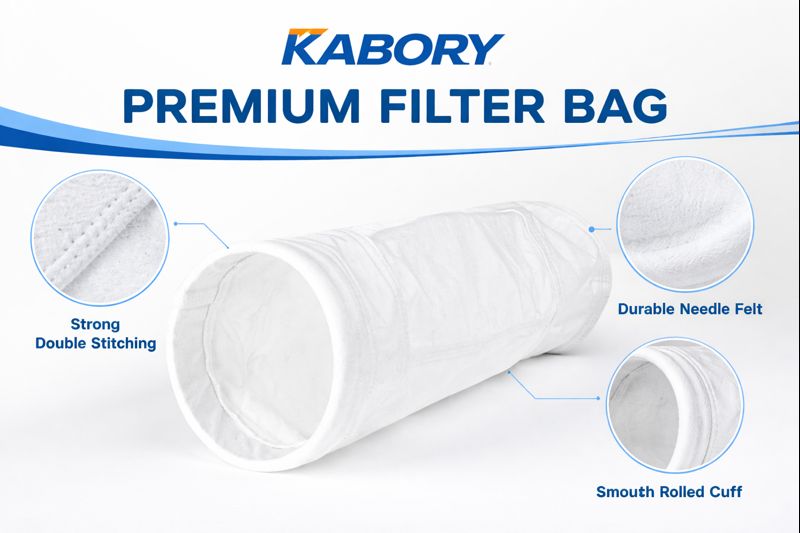
PTFE Needle Felt
PTFE Needle Felt is a high-performance needle-punched filter media manufactured from 100% virgin PTFE fibers (Teflon® polymer based).
It is engineered for extreme high-temperature and corrosive gas filtration, offering exceptional chemical inertness, thermal stability, and long-term operational reliability.
Designed with fine-denier fibers (3D–5D) and a balanced base fabric structure, it delivers uniform filtration performance without base fabric exposure or density variation.
Description
100% PTFE Needle-Punched Filter Media for Extreme Industrial Conditions
PTFE (Polytetrafluoroethylene) needle felt is a premium needle-punched filtration medium manufactured entirely from 100% PTFE fibers, specifically engineered for continuous operation under extreme chemical, thermal, and corrosive environments where conventional filter media fail.
Unlike blended materials or surface-treated felts, PTFE needle felt relies exclusively on the intrinsic properties of the PTFE polymer itself, ensuring long-term stability, predictable filtration behavior, and resistance to chemical or thermal degradation throughout its service life.
Technical Summary
-
100% PTFE needle felt for extreme chemical and thermal environments
-
Fine-denier PTFE fibers (3D–5D) for uniform fiber architecture
-
Virgin PTFE fibers only — no recycled offcuts, no mixed high-temperature fibers
-
Clean, homogeneous felt structure with no visible speckling under transmitted light
-
120 g/m² base fabric for balanced mechanical stability
-
Designed to eliminate base fabric exposure, density variation, and localized weak zones
-
Optimized for long-term operational reliability in pulse-jet and reverse-air systems
Material Architecture & Manufacturing Concept
Fiber Composition
-
100% PTFE fibers
-
No blended fibers
-
No carrier or supporting fibers
Structural Design
-
Multi-layer needle-punched non woven construction
-
Controlled fiber orientation and layering
-
Mechanical entanglement combined with thermal stabilization
Resulting Material Characteristics
-
Chemically inert filtration matrix
-
Dimensional stability under thermal cycling
-
Uniform pore structure across the full felt thickness
This construction avoids the risks associated with coatings, chemical finishes, or surface treatments that may degrade under high temperature or aggressive gas conditions.
Core Performance Characteristics
Thermal Stability
-
Continuous operating temperature: up to 250 °C
-
Short-term peak temperature: up to 280 °C
-
No embrittlement, melting, or structural collapse during thermal cycling
PTFE maintains molecular stability far beyond the limits of polyester, PPS, or Aramid fibers.
Chemical Inertness
-
Resistant to strong acids, strong alkalis, oxidizing gases, solvents, and corrosive by-products
-
Chemically inert across the full industrial pH range
-
No hydrolysis, no oxidation aging
This makes PTFE needle felt particularly suitable for chemical processing, waste incineration, and corrosive exhaust gas filtration.
Filtration Behavior
-
Uniform pore distribution throughout the felt thickness
-
High dust-holding capacity with stable pressure-drop development
-
Suitable for fine and sub-micron particulate capture
The depth-filtration mechanism allows particles to be retained within the felt structure rather than forming unstable surface cakes.
Clean ability & Operational Stability
-
Extremely low surface energy of PTFE fibers
-
Reduced dust adhesion and efficient dust release
-
Compatible with pulse-jet and reverse-air cleaning systems
This results in lower cleaning frequency, reduced compressed-air consumption, and stable long-term filtration performance.
Typical Physical Properties (Reference Range)
| Property | Typical Range |
|---|---|
| Fiber material | 100% PTFE |
| Weight range | 700–900 g/m² (customizable) |
| Thickness | Engineered per application |
| Air permeability | Controlled / application-specific |
| Max. continuous temperature | 250 °C |
| Chemical resistance | Excellent |
Exact specifications are defined based on actual operating conditions.
Application Environments
PTFE needle felt is selected for applications where process reliability outweighs initial material cost, including:
-
Waste-to-energy and hazardous waste incineration
-
Chemical and petrochemical processing plants
-
Non-ferrous metal smelting and refining
-
Aggressive industrial exhaust gas filtration
-
High-temperature and high-corrosion dust collectors
In these environments, PTFE needle felt provides predictable service life and stable filtration performance, even under fluctuating operating conditions.
PTFE Needle Felt vs. Conventional Filter Media
| Aspect | PTFE Needle Felt | Conventional Media |
|---|---|---|
| Chemical resistance | Intrinsic, permanent | Limited / surface-dependent |
| Thermal stability | Excellent | Moderate |
| Aging behavior | Minimal | Progressive degradation |
| Filtration consistency | Stable over time | Declines with aging |
| Total cost of ownership | Lower (long term) | Higher (frequent replacement) |
Engineering-Driven Customization
PTFE needle felt can be supplied with application-specific configurations:
-
Optimized weight and thickness profiles
-
Surface conditioning for improved cleanability
-
PTFE membrane lamination for ultra-fine particle control
-
Custom designs for pulse-jet or reverse-air systems
All configurations are defined according to actual operating parameters, not generic catalog values.
Manufacturing Technology & Fiber Engineering
Processing Challenges of PTFE Needle Felt
The production of PTFE needle felt requires specialized manufacturing technology and strict process control.
Due to the low friction coefficient and poor cohesion of PTFE fibers, carding and web formation are inherently difficult.
If fiber opening and distribution are not precisely controlled, common industry-wide defects occur:
-
Base fabric exposure caused by insufficient fiber coverage
-
Non-uniform thickness and density
-
Localized weak zones leading to premature failure under pulse-jet cleaning
Fine-Denier Fiber Strategy (3D–5D)
We manufacture PTFE needle felt using fine-denier PTFE fibers in the 3D–5D range.
Most products in the market are produced using coarser fibers in the 5D–7D range or even higher.
Engineering advantages of finer fibers:
-
Improved fiber opening and dispersion during carding
-
More uniform fiber distribution across the felt surface
-
Reduced risk of local density variation
-
More consistent pore structure and filtration behavior
Fine fibers are more demanding to process, but they are essential for producing uniform, high-integrity PTFE needle felts.
Virgin Fiber Policy
We strictly use 100% virgin PTFE fibers.
Common industry practices include:
-
Reusing production offcuts after re-opening
-
Blending recycled fibers into the web
-
Mixing other high-temperature fibers for cost reduction
These practices often result in visible fiber agglomerations, appearing as dark specks or mottled areas when inspected under transmitted light.
Our use of pure virgin PTFE fibers ensures:
-
Uniform fiber color and dispersion
-
No visible speckling
-
Clean, homogeneous felt structure
-
Stable and predictable filtration performance
Base Fabric Selection (120 g/m²)
We deliberately use a 120 g/m² base fabric, compared with the 160 g/m² base fabric commonly used in the industry.
This is an engineering decision, not a cost compromise:
-
Reduces stiffness mismatch between felt and scrim
-
Improves fiber-to-scrim integration
-
Avoids “false strength” created by heavy scrims masking poor fiber distribution
-
Enhances long-term mechanical stability under cyclic cleaning
Controlled Fiber Architecture
Our manufacturing philosophy focuses on fiber-level control rather than compensatory design:
-
Precise carding and layering of fine PTFE fibers
-
Uniform bonding between fibers and base fabric
-
Consistent thickness and density across the entire roll
This results in predictable filtration behavior and long-term operational stability, even under aggressive industrial conditions.
Why Experienced Operators Select PTFE Needle Felt
PTFE needle felt is not a commodity product.
It is selected when:
-
Process stability is critical
-
Downtime is costly
-
Chemical or thermal failure is unacceptable
For these applications, PTFE needle felt delivers long-term operational reliability rather than short-term cost savings.