
Filter Media Roll Slitting Machine – Needle Felt and Fiberglass
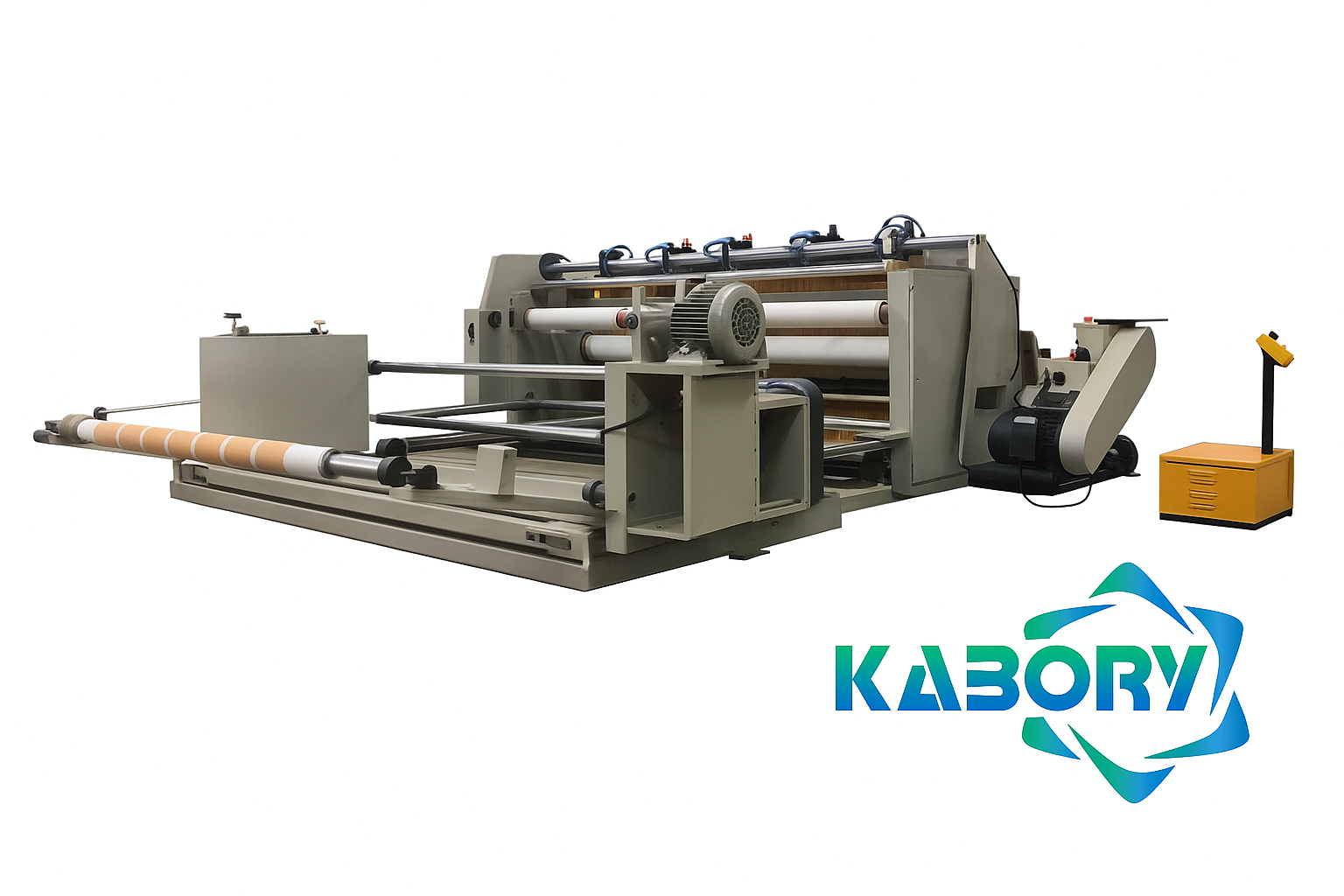
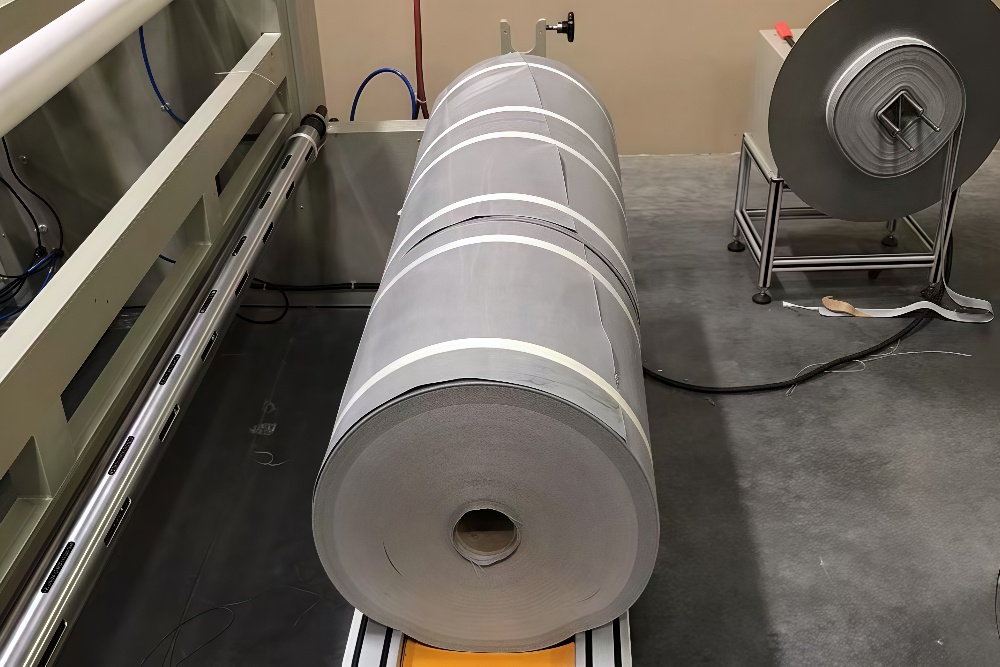
High-precision roll-to-roll filter media slitting machine for needle felt and fiberglass, engineered with stable tension control to deliver clean edges and reliable continuous production.
Description
High-Precision Filter Media Roll Slitting Machine – System Overview
Advanced Filter Media Slitting System with Stable Tension Control
This roll slitting machine is engineered for modern filter media production, specifically for needle felt, fiberglass filter media, and PTFE-laminated materials processed in wide-format rolls.
Unlike conventional slitting machines developed mainly for standard nonwovens, this system is designed from the outset to address the high stiffness of fiberglass materials, fiber brittleness, and extreme sensitivity to both tension and cutting force.
As a result, it fundamentally solves common production issues such as web deviation, edge fraying, filament breakage, edge damage, and heavy dependence on manual adjustment.
By integrating advanced tension control, real-time deviation correction, and nylon-coated roller technology, the machine delivers clean edges, stable widths, and reliable high-speed slitting across demanding filtration applications
Industry Background | Requirements for Filter Media Roll Slitting Machines
As filtration manufacturers face increasing demands for product consistency, production stability, and higher output, filter media slitting has evolved from a simple cutting step into a critical, precision-controlled, continuous production process.
In real factory conditions—especially when processing wide fiberglass rolls and PTFE-laminated filter media—cutting quality is no longer determined by the blade alone.
Instead, it is the overall stability of the slitting system that defines long-term production results.
🟠 In this context, tension control has become the core of modern filter media roll slitting.
Even minor tension fluctuations will directly affect:
-
Edge straightness and cleanliness
-
Long-term width consistency
-
Fiber integrity and risk of filament breakage
-
The frequency of manual intervention
Technical Concept | A Slitting Architecture Built Around Tension Control
In filter media roll slitting, tension is not an isolated parameter.
It is the central design logic that runs through the entire machine.
Most slitting problems encountered in production can ultimately be traced back to one or more of the following:
-
Unstable tension generation
-
Uncontrolled tension transmission
-
A mismatch between tension release and cutting method
This machine is therefore engineered around a single core objective:
fully controllable, stable, and finely adjustable tension throughout the entire slitting process.
Magnetic Powder Clutch & Pneumatic Air Shaft for Filter Media Roll Slitting Machine
Tension is first established at the unwinding and rewinding sections, where both tension generation and roll clamping stability are critical to overall slitting performance.
Magnetic powder clutches are installed on both the unwinding and rewinding ends to precisely regulate tension during material release and rewinding. This system provides:
🟠 Linear, adjustable, and stable tension output
🟠 Elimination of tension spikes caused by friction brakes or basic inverter control
🟠 Predictable tension behavior during start-up, acceleration, deceleration, and continuous operation
To ensure that this controlled tension is transmitted evenly into the material, the machine is equipped with pneumatic air shafts on both unwinding and rewinding sections.
The inflatable air shaft expands uniformly along the core, providing secure and concentric clamping of wide and heavy filter media rolls. This is especially important for fiberglass and PTFE-laminated materials, where uneven mechanical clamping can introduce localized stress, tension fluctuation, or edge distortion.
Compared with conventional mechanical chucks, the pneumatic air shaft enables:
🟠 Faster and safer roll changeover
🟠 Improved roll concentricity under load
🟠 More stable tension transmission during continuous slitting
🟠 Engineering significance
Only when tension is generated in a controlled manner (magnetic powder clutch) and transferred into the roll uniformly (pneumatic air shaft) can downstream slitting, web guiding, and blade systems perform consistently and predictably.
2️⃣ Automatic Web Guiding in Filter Media Slitting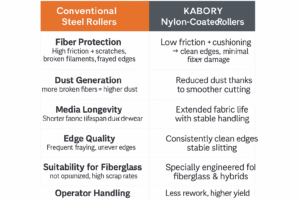
The purpose of web guiding is not to “pull” the material, but to correct lateral deviation under stable tension conditions.
When tension is unstable:
-
Guiding movements become exaggerated
-
Frequent corrections introduce additional edge stress
-
Edge waviness and fraying are amplified
This system combines hydraulic roll loading with high-precision automatic guiding (±200 mm), designed on the premise that:
-
Tension is continuously stabilized by the clutch system
-
Wide rolls remain geometrically stable
-
The guiding system performs position correction only, not tension compensation
🟠 Core principle
Stabilize tension first, then control position.
3️⃣Nylon-Coated Rollers for High-Precision Filter Media Roll Slitting
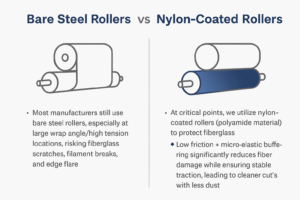
In operation, tension is not applied instantaneously—it is transmitted progressively through multiple rollers.
Under high tension and large wrap angles, bare steel rollers tend to cause:
-
Localized contact stress
-
Fiber scratching and filament breakage
-
Increased edge fraying and dust generation
Key rollers in this machine are equipped with nylon (polyamide) coatings. Their role is not to reduce tension, but to:
-
Smooth the tension transmission process
-
Provide micro-elastic buffering to absorb instantaneous stress
-
Protect fiber structure without sacrificing traction stability
🟠 Essential distinction
Bare steel rollers transmit rigid tension.
Nylon-coated rollers transmit controlled, releasable engineering tension.
4️⃣ Dual Blade System | Material-Specific Cutting on a Unified Tension Platform
Different filter media exhibit fundamentally different cutting behaviors.
Needle-punched felts, as flexible nonwoven materials, require
blades optimized for:
-
Cutting stability
-
Wear resistance
-
Adaptability to thickness variation
Fiberglass and PTFE-laminated materials, by contrast, are high-stiffness media extremely sensitive to both tension and cutting force. They require:
-
Continuous and uniform cutting pressure
-
Fine adjustability of blade force
-
Elimination of instantaneous impact that leads to filament breakage
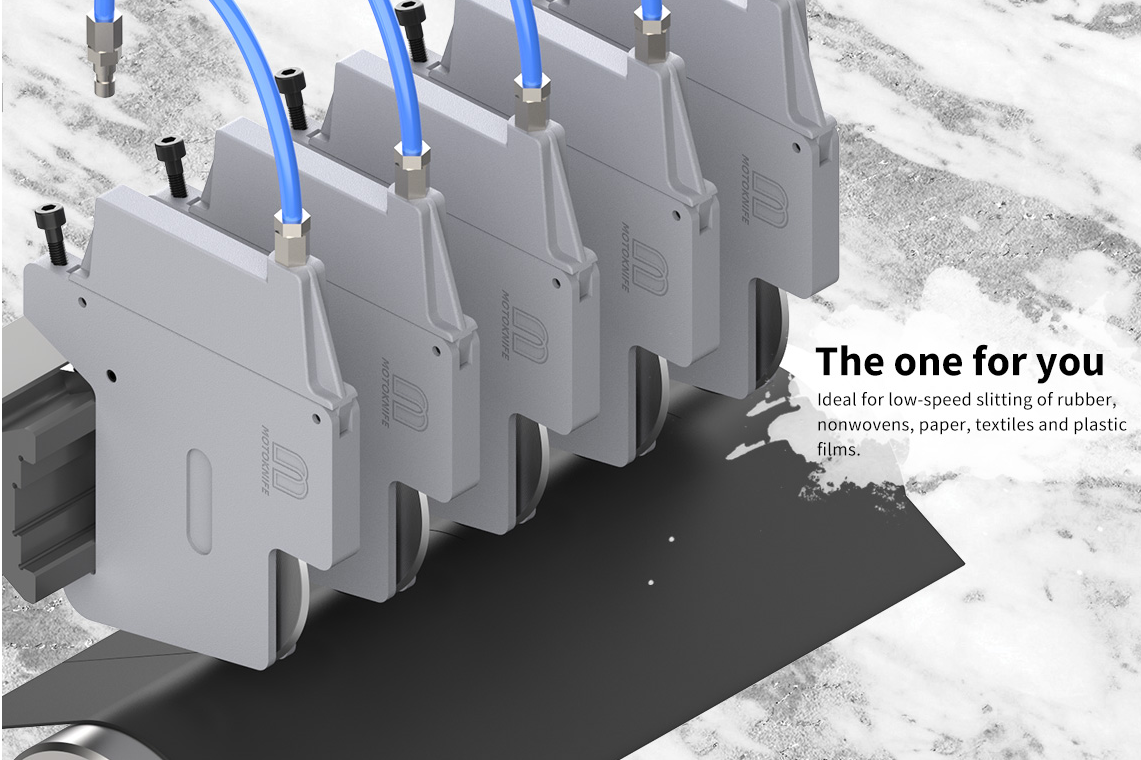
To address this, the machine integrates two independent blade systems within a single slitting platform:
-
Mechanical slitting blade system
Designed for high-speed, continuous slitting of needle felt and other flexible filter media, offering proven reliability for long production runs. -
Pneumatic pressure-controlled blade system
Designed for fiberglass and PTFE-laminated media, using air pressure regulation to deliver continuous, precisely controlled cutting force, minimizing fiber damage and tearing.
Both blade systems operate on the same stable tension control platform, ensuring consistent behavior across different materials.
5️⃣ Engineering Value of the Integrated Design | One Machine, Multiple Slitting Conditions
Integrating two blade systems into one slitting machine is not feature stacking—it is a system-level engineering decision:
-
No need to rebuild the tension system when switching materials
-
One machine covers both needle felt and fiberglass slitting
-
Reduced downtime from machine or line changes
-
Lower operator workload and reduced reliance on experience
-
Consistent cutting quality across different materials and modes
🟠 Final result
High-speed efficiency for needle felt
and stable, fiber-safe cutting for fiberglass and laminated filter media.
Production Results | Direct Benefits of a Stable Tension System
When tension is systematically controlled across generation, transmission, release, and cutting, production results change fundamentally:
-
Clean, straight slit edges
-
No fiber stretching or fraying
-
Long-term width consistency with reduced scrap
-
Standardized operation with lower labor intensity
-
Stable quality during extended continuous operation
🟠 This is why, in filter media roll slitting, truly reliable machines are always designed around tension systems—not just blades or speed.
Applicable Materials and Applications
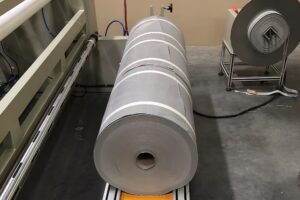
Compatible Materials
-
Needle-punched filter felts
-
Fiberglass filter media
-
PTFE-laminated filter media
-
Fiberglass composite media
-
Technical nonwoven materials
Typical Applications
-
Dust collector filter bag production
-
Filter cloth width pre-slitting
-
Media preparation for liquid and gas filtration
-
High-temperature fiberglass filter media processing
Technical Specifications
| Item | Specification |
| Cutting Width | 800 – 2600 mm |
| Max Unwinding Diameter | 1200 mm |
| Slitting Speed | 0 – 30 m/min |
| Pneumatic Blades | 6 – 8 |
| Voltage | 220V / 50Hz |
| Power | 3.1 kW |
| Tension Control System | Dual-end magnetic powder clutch |
| Deviation Correction | Hydraulic lifting rack with auto-centering |
| Rollers | Nylon-coated for fiberglass protection |
Summary Benefits
✔️ Consistent Cutting Quality – Clean edges with minimal fraying or dust
✔️ Material Savings – Reduced waste and higher yield on expensive fiberglass/PTFE media
✔️ Labor Reduction – Automated lifting and alignment, easier handling
✔️ Operator Safety – Less manual rework, reduced strain
✔️ Proven Market Reliability – Already validated in North American filter media plants
Why Choose KABORY Filter Media Roll Slitting Machine
With decades of expertise in filtration equipment, KABORY combines advanced engineering, strict quality control, and proven customer success to deliver solutions that last. Our machines and filter media are trusted worldwide in cement plants, steel mills, incinerators, mining operations, and chemical industries.
Take the Next Step
Don’t let outdated processes or unstable equipment hold your factory back. Upgrade with KABORY’s high-performance solutions to gain:
-
Higher output with fewer operators
-
Longer service life under extreme conditions
-
Reduced maintenance, downtime, and waste
-
Stronger ROI and lower total cost of ownership
📩 Contact us today to learn how KABORY can optimize your filtration production line.