
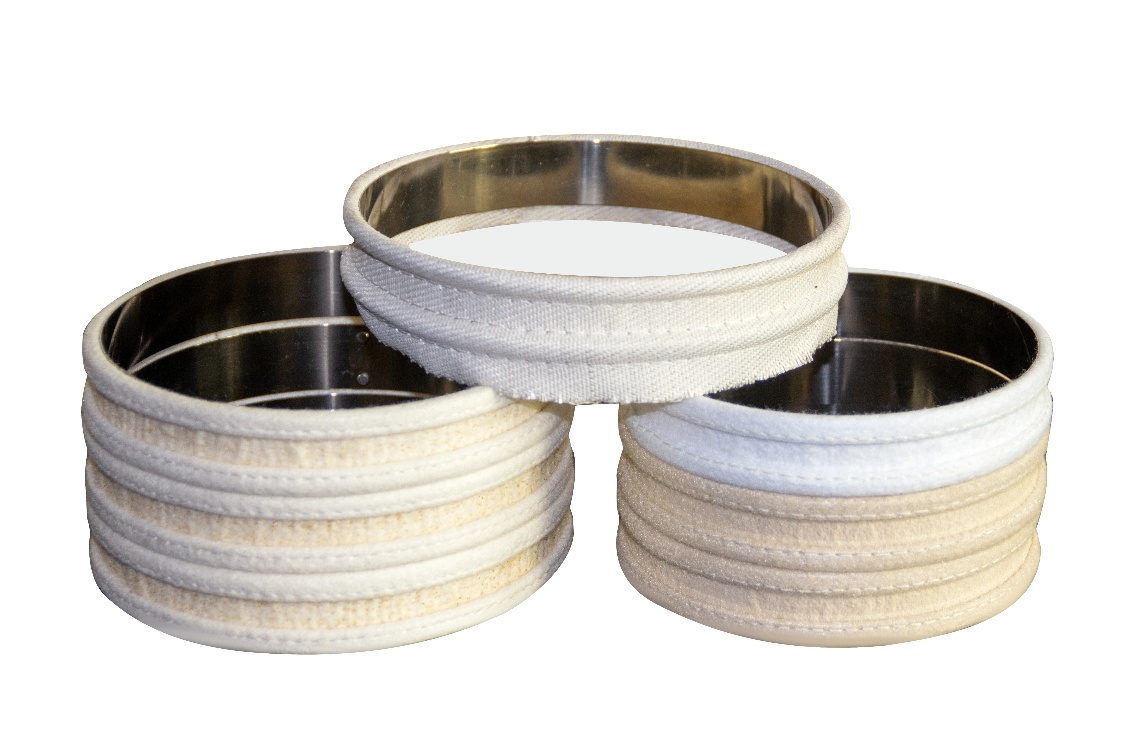
Automatic Snap Band Welding Machine – High-Speed Rivet-Free Welding for Stainless Steel Bands and Sealing Rings
AWorld’s first fully automatic snap band welding machine, engineered for industrial filtration systems.
By replacing rivets and mechanical fastening with continuous metallurgical bonding, this machine delivers superior structural continuity, long-term sealing reliability, and consistent quality for stainless steel snap bands used in filter bags, flexible connectors, and sealing rings.
Description
World’s First Automatic Snap Band Welding Machine
Defining the Metallurgical Standard for Snap Band Joining in Industrial Filtration Systems
Designed for industrial filtration, dust collection, ventilation, and flexible connector sealing systems where long-term sealing reliability is critical.
Industry Background: Why Snap Band Joining Really Matters
In industrial filtration systems, snap bands are not simple accessories.
They are critical sealing and structural components, responsible for maintaining consistent compression and airtight performance throughout long-term operation.
In real operating environments, snap bands must withstand:
-
Continuous pulse-jet cleaning vibration
-
Repeated thermal expansion and contraction
-
Sustained radial compression loads
-
Long-term operation without loosening, deformation, or loss of sealing force
Under these conditions, joint fatigue resistance and circumferential geometric continuity directly determine sealing integrity, system reliability, and maintenance intervals
Why Traditional Mechanical Fastening Is Fundamentally Limited
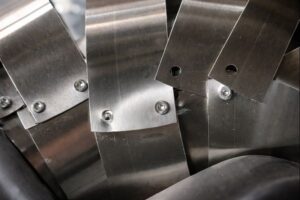
Conventional snap band manufacturing relies on mechanical fastening methods, typically including rivets, punched stainless steel strip ends, or localized spot welds.
In standard-duty filtration applications, riveted snap bands have proven reliable and have been widely adopted across the industry.
However, from a structural engineering perspective, mechanically fastened snap bands inherently introduce localized load paths and stress concentration points at drilled holes and fastening interfaces.
In addition, punching operations on stainless steel strips may generate burrs, edge curling, or localized deformation, depending on material hardness, strip thickness, and tooling condition.
These edge irregularities can create sharp local contact points along the inner circumference of the snap band.
Under real operating conditions—such as pulse-cleaning vibration, thermal cycling, and continuous compression loads—these localized features may gradually abrade or cut the filter bag fabric, particularly in high-frequency or high-temperature operating environments.
As industrial filtration and containment systems continue to evolve toward:
-
Higher operating temperatures
-
Higher pulse-cleaning frequency
-
Longer maintenance intervals
-
Continuous multi-shift duty cycles
the limitations of mechanically fastened snap band structures become increasingly pronounced.
This is not a manufacturing quality issue.
It is a fundamental limitation of mechanical joint design.
No matter how carefully executed, mechanically fastened snap bands remain assemblies composed of discontinuous structural segments.
From Mechanical Fastening to Continuous Metallurgical Bonding
To address these inherent structural limitations, KABORY developed the world’s first fully automatic Snap Band Welding Machine, engineered specifically for industrial filtration snap band applications.
Instead of relying on mechanical fastening, this system joins snap band ends using four-point controlled fusion welding, forming a continuous metallurgical bond.
This process:
-
Eliminates rivets, punched holes, and discrete fastening interfaces
-
Removes localized stress concentration points
-
Preserves uniform stiffness and geometry along the full circumference
In this system, the snap band is no longer assembled.
It is structurally continuous.
The joint is no longer a connection point, but an integral part of the ring itself, enabling uninterrupted load transfer and true metallurgical continuity.
Engineering Validation of the Automatic Snap Band Welding Machine Under Real Operating Conditions
Long-term sealing reliability is not achieved by increasing local joint strength alone.
It is achieved by eliminating structural discontinuities altogether.
By replacing mechanical fastening with continuous metallurgical bonding, the Automatic Snap Band Welding Machine directly addresses the primary failure mechanisms observed in long-term filtration service:
-
Fatigue cracking initiated at joint interfaces
-
Progressive loosening under vibration
-
Loss of sealing force caused by uneven circumferential stiffness
The result is a snap band structure capable of maintaining stable geometry and consistent sealing performance throughout extended service life.
Real Tensile Strength Test Comparison
Material: SUS301 Stainless Steel
Thickness: 0.40 mm (Welding) 0.45mm(Riveted)
Condition: Same material hardness
| Joint Type | Tensile Strength (N) | Difference |
| Riveted Joint | ≈ 4,200 N | baseline |
| Welded Joint | ≈ 7,200 N | +71% improvement |
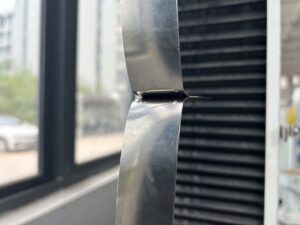
The welded joint demonstrates a clear transition from fastener-dependent separation to uniform metal yielding, indicating a fundamentally stronger and more stable joint structure.
Automation Advantages of the Automatic Snap Band Welding Machine for Structural Consistency
Automation in this system is not introduced merely to increase production speed.
Its primary purpose is to ensure:
-
Consistent weld quality independent of operator skill
-
Repeatable joint geometry and metallurgical integrity
-
Stable production rhythm for industrial-scale manufacturing
-
Seamless integration into automated filter bag production lines
By combining controlled fusion welding with automated positioning and process control, the machine delivers repeatable structural performance, not variable craftsmanship.
Key Technical Advantages
-
Continuous metallurgical joint without rivets or punched holes
-
Uniform circumferential stiffness and load distribution
-
Superior resistance to vibration, thermal cycling, and fatigue
-
Highly consistent welding quality through full automation
-
Designed specifically for stainless steel snap bands used in industrial filtration
Production Workflow
The Automatic Snap Band Welding Machine integrates forming, joining, and quality consistency into a single continuous production workflow:
-
Automatic coil feeding
-
Fixed-length cutting
-
Snap band forming
-
Four-point controlled fusion welding
-
Output counting and stacking
Stable Production Output of the Automatic Snap Band Welding Machine
-
8–10 pcs/min
-
≈ 2,800 pcs per 8-hour shift
-
One operator can manage multiple production lines
Technical Specifications
| Parameter | Specification |
| Diameter Range | 90–220 mm / 90–300 mm (customizable) |
| Steel Band Thickness | 0.20–0.50 mm |
| Steel Band Width | 25–30 mm |
| Edge Alignment Accuracy | ±0.30 mm |
| Joint Structure | Four-Point Controlled Fusion Welding |
| Output Capacity | 8–10 pcs/min |
| Power | 380–480 V, Three-phase |
| Air Supply | 0.5–0.7 MPa |
| Control System | PLC Automatic Control |
| Welding Technology | Four-Point Controlled Fusion Welding |
| Control System | PLC-based automatic control |
| Operation Mode | Automatic feeding, positioning, cutting, and welding |
| Material Compatibility | Stainless steel snap bands |
| Safety Features | Emergency stop, protective housing |
| Control System | PLC Automatic Control |
A Structural Redefinition Enabled by the Automatic Snap Band Welding Machine
The development of the Automatic Snap Band Welding Machine was not driven by automation alone.
It was driven by a fundamental engineering question:
How should a snap band be joined if long-term sealing reliability truly matters?
By replacing mechanical fastening with continuous metallurgical bonding, this system establishes a new reference point for snap band manufacturing in industrial filtration.
It is not an incremental improvement.
It is a structural redefinition.
Conclusion: Why the Automatic Snap Band Welding Machine Defines a New Standard
Snap band reliability is not determined by material selection alone, nor by localized joint strength.
It is determined by structural continuity, fatigue behavior, and long-term geometric stability.
The Automatic Snap Band Welding Machine represents a decisive shift away from mechanically assembled snap bands toward continuous, metallurgically bonded structures—designed to meet the real demands of modern industrial filtration systems.