
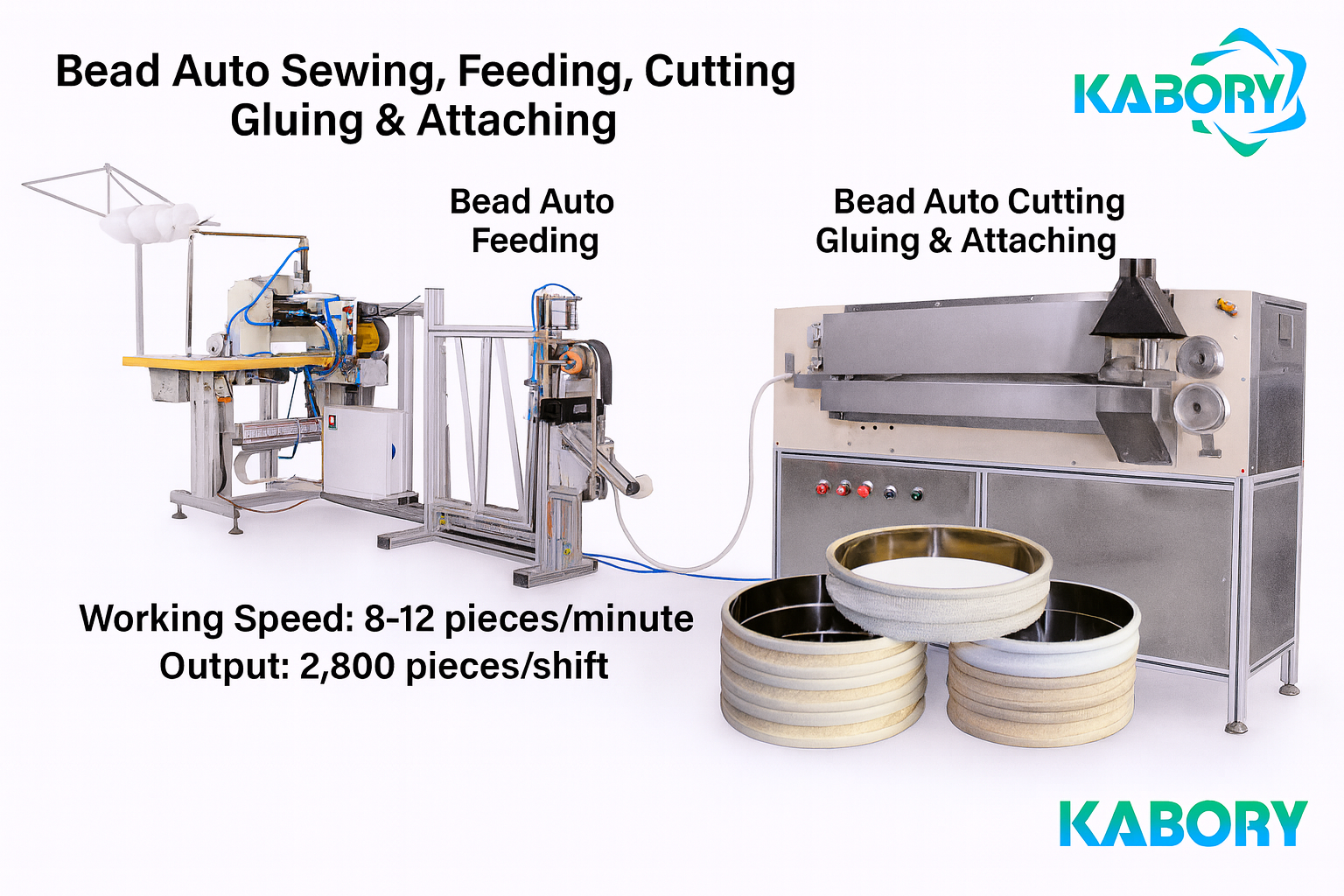
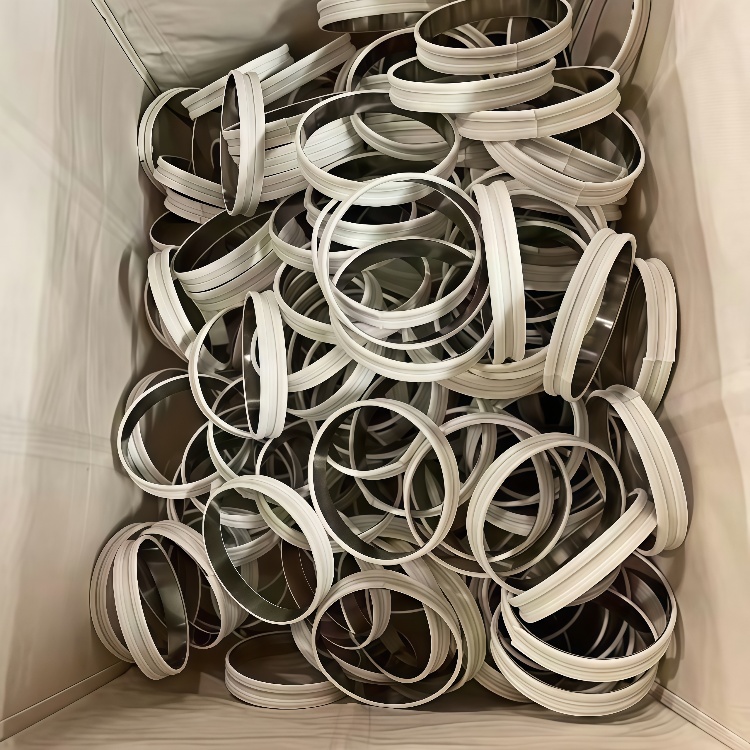
Automatic Bead Sewing and Attaching Machine – For Filter Bag Bead/Profile Tape Processing
KABORY is the first in the industry to deliver a truly automated bead sewing, cutting, gluing, and attaching system that guarantees a stable output of 8 pieces per minute — not only in testing, but in real factory production.
With a consistent 8 pcs/min operating speed, reaching up to 2,800 pieces per shift, the system replaces four manual stations with just one operator, significantly reducing labor costs while delivering perfectly uniform quality across every shift
Description
🌍 World’s First Automatic Bead Sewing and Attaching Line
Proven Through Years of Engineering Validation
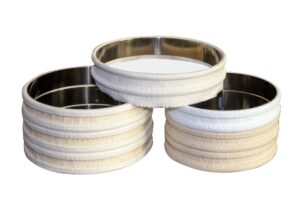
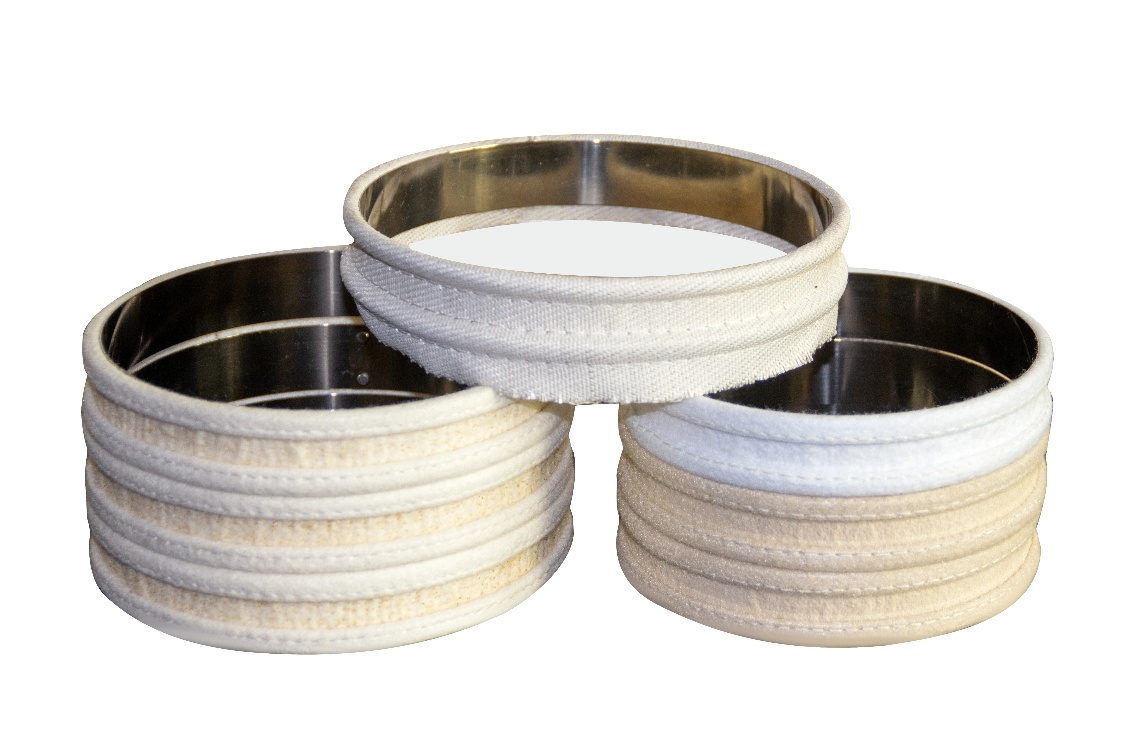
KABORY’s automated bead/Profile Tape sewing and attaching system is specifically engineered for industrial filter bag production, enabling high-speed, stable, and repeatable sewing and attaching of bead/profile tape onto snap bands under real, multi-shift factory operating conditions.
KABORY is the first manufacturer worldwide to successfully achieve automated integration of bead/profile tape sewing, fixed-length cutting, adhesive application, and attaching, and to bring this system into large-scale industrial production.
This is not a conceptual or experimental solution, but a mature production system developed through years of engineering refinement and continuous multi-shift field validation.
During production, bead sewing, cutting, gluing, and attaching are performed automatically by the system, while the final placement of the snap ring is completed manually, resulting in a highly automated yet engineering-controlled production model.
Under a long-term stable output of 8 pieces per minute, the system consistently delivers uniform seam quality, precise edge alignment, and reliable bonding strength.
At this stable production rate, a single line can produce up to 2,800 snap bands per shift, while maintaining repeatable process parameters and consistent attaching quality throughout continuous operation.
Unlike traditional production methods that typically require four separate workstations and more than six operators to perform bead sewing, cutting, gluing, and attaching, the KABORY system integrates multiple critical processes into a single automated production line, requiring only one operator to support the entire workflow.
This significantly reduces dependence on labor quantity and operator skill levels, while simplifying production management and improving overall process consistency.
Bead/Profile tape Accumulator — System-Level Control for Continuous, Stable Bead Processing
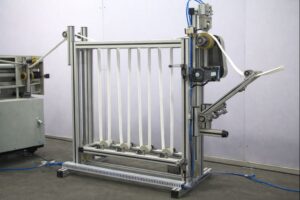
The integrated Bead Accumulator is a core system-level design that creates a controlled buffer between bead feeding, sewing, cutting, and gluing processes.
It decouples bead tension and speed fluctuations between upstream and downstream operations, ensuring stable bead positioning throughout continuous production.
By maintaining constant tension and controlled bead storage, the accumulator prevents sudden pulling, stretching, deformation, or misalignment—common issues in conventional or semi-automatic bead sewing setups.
This stability is especially critical during long production runs, speed transitions, and multi-shift operation.
Unlike simple mechanical feeding solutions, the Bead Accumulator is fully integrated into the line architecture, requiring precise synchronization, layout design, and tolerance control.
This system-level approach ensures repeatable bead geometry, consistent joint quality, and long-term process stability, making it difficult to replicate without complete line engineering.
Diagonal Cutting Design for Improved Bead End-to-End Joint Quality
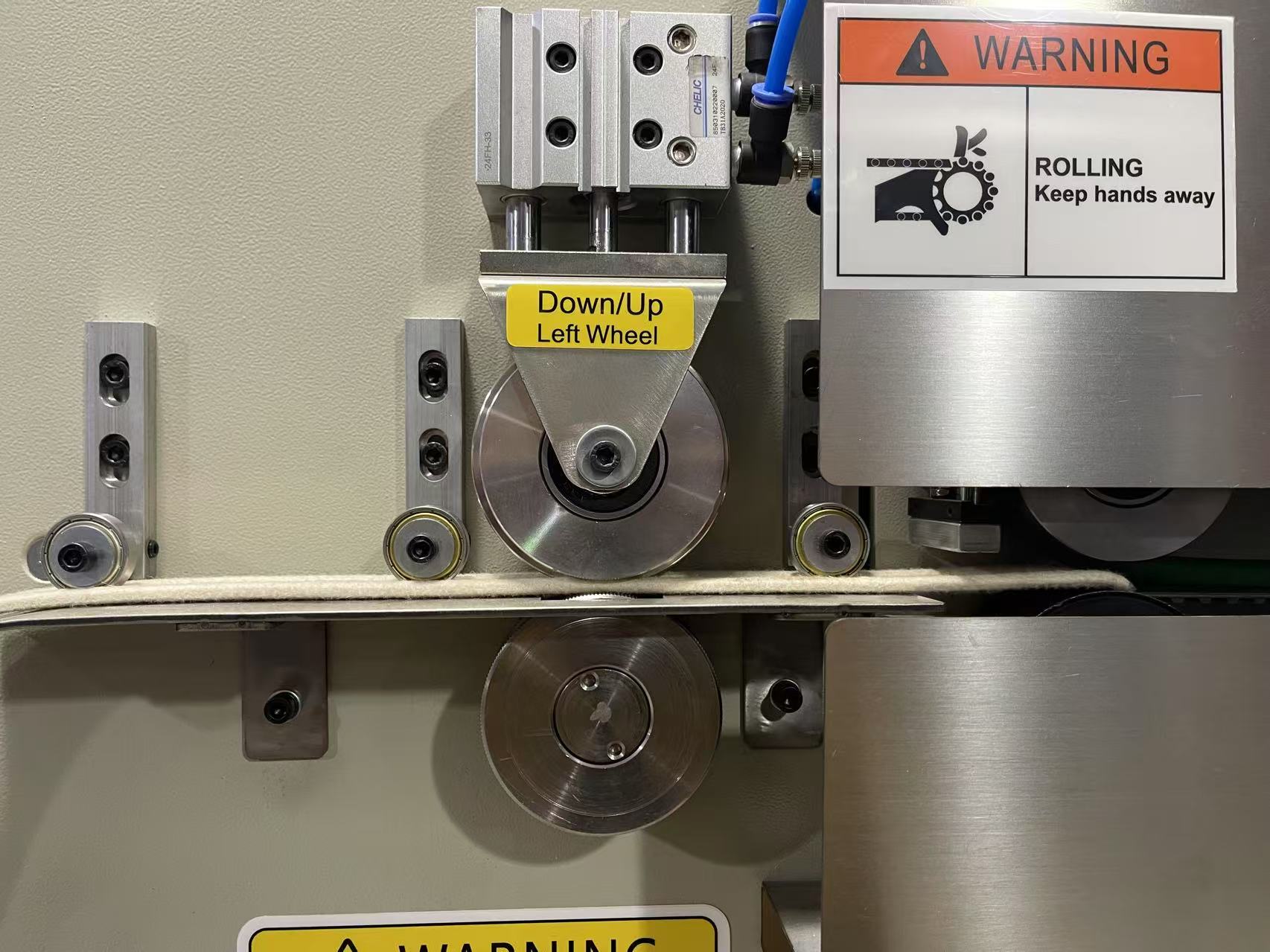
During the fixed-length cutting process of bead/profile tape, KABORY adopts a diagonal cutting method instead of a conventional straight cut.
This design increases the effective contact area at the bead joint, allowing smoother end-to-end alignment during attaching and reducing step mismatch or misalignment at the connection point.
Compared with straight cutting, diagonal cutting provides improved joint stability during subsequent sewing and adhesive bonding.
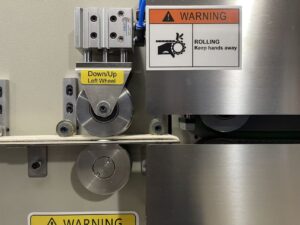
The angled interface helps distribute mechanical stress more evenly at the joint, minimizing localized concentration and reducing the risk of joint deformation during continuous operation.
As a result, the bead maintains better continuity and geometric consistency throughout long-term use.
This detail-oriented cutting design further enhances the overall quality of bead sewing and attaching, providing a more stable structural foundation for long-term bonding reliability and repeatable production quality.
Fundamental Difference in Adhesive Technology
Compared with Traditional Double-Sided Tape Methods
For bead/profile tape fixing, KABORY employs an industrial-grade adhesive solution specifically designed for filter bag applications, rather than conventional double-sided tape used for temporary positioning.
Under long-term operation and storage conditions, traditional double-sided tape is prone to aging, moisture absorption, and degradation under elevated temperatures, often resulting in loss of adhesion within 6–12 months, leading to rework risks and quality complaints.
By contrast, the adhesive process used in the KABORY system has been validated through long-term field operation.
Under normal storage and application conditions, it can maintain stable bonding performance for more than two years without detachment.
This long-term stability significantly reduces rework caused by adhesive failure and ensures that bead positioning and attachment remain reliable throughout the filter bag’s production, storage, and service lifecycle.
This field-proven automated production process not only substantially reduces labor costs, but also improves effective production efficiency by minimizing rework and quality variation.
At the same time, stable output and reliable bonding performance help manufacturers improve delivery predictability, shorten lead times, and strengthen overall competitiveness in the filter bag market.
The system is suitable for polyester, PPS, aramid, PTFE, P84, fiberglass, and other technical filter media, making it a reliable automation solution for filter bag manufacturers focused on high output, strong consistency, and scalable long-term growth.
The true value of automation lies not only in labor reduction,
but in long-term stability, minimal rework, and predictable quality and delivery performance.。
How the Bead Sewing and Attaching Machine Improves Filter Bag Production
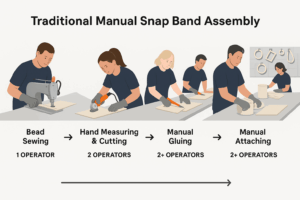
Traditional bead/profile tape processing depends on Manual Sewing, Manual Cutting, Manual Taping, and Manual Attaching.
This four-station workflow requires 6–7 operators, consumes large floor space, and produces inconsistent bead positioning, unstable tension, and frequent rework.
The Automatic Bead Sewing & Attaching Machine replaces these labor-intensive steps with a single automated workflow, ensuring continuous, high-precision processing.
Servo-controlled feeding and synchronized sewing maintain consistent stitch quality and accurate alignment. The automated gluing module delivers precise adhesive volume, eliminating over-gluing and under-gluing. Digital control minimizes operator influence, ensuring repeatable bead dimensions and bonding strength across all shifts.
This level of automation fundamentally optimizes traditional labor-heavy workflows and enables factories to scale production without adding manpower or expanding floor space.
Automated Workflow of the Bead Sewing and Attaching Machine
- 🔢Bead/Profile Tape Fully Automatic Sewing with Chain Stitch
- 🔢 Bead/Profile Tape Automatic Fixed-Length Cutting
- 🔢 Snap Band Placement (manual)
- 🔢 Automatic Bead Attaching to the Snap Band
- 🔢Tension-Controlled Loop Accumulator Between Sewing and Gluing
Advantages of the Bead Sewing and Attaching Machine
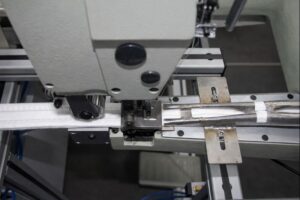
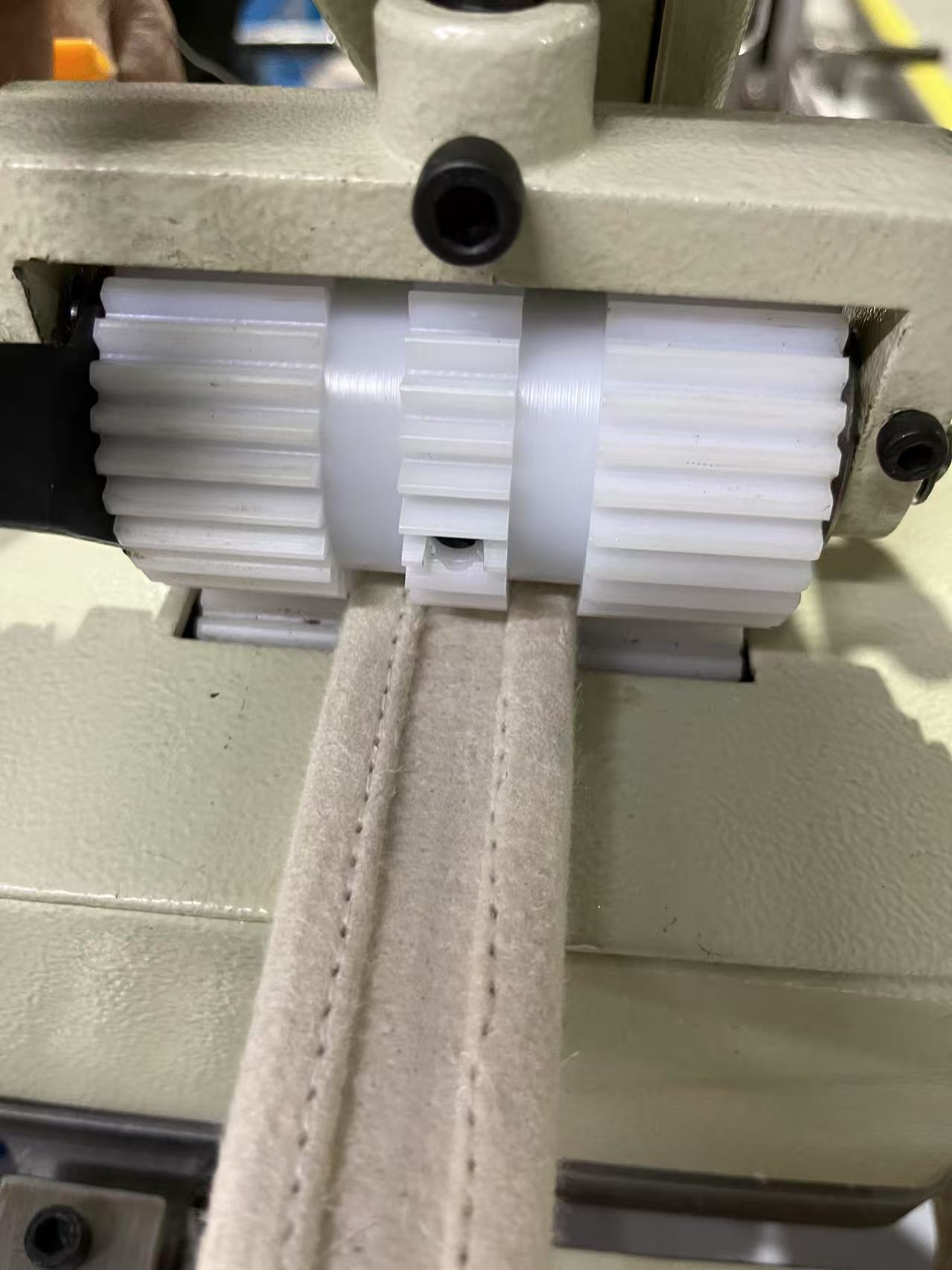
The bead is sewn through approximately 3.5 material layers, achieving excellent alignment and highly consistent stitch quality.
Precision Bead Sewing
Precision sewing of a 25 mmor 30mm bead with a 10 mm center groove through ~3.5 material layers, ensuring excellent alignment and stitch consistency.
-
-
Bead Accumulator for Stable Feeding
System-level bead accumulator stabilizes tension and ensures smooth, continuous feeding during long production runs. -
Diagonal Cutting for Seamless Bead Joining
Controlled diagonal cutting improves end-to-end alignment and joint stability before sewing and adhesive bonding. -
One-Operator Operation
Replaces multiple workstations and operators with one synchronized production system. -
Guaranteed Long-Term Output — 8 pcs/min
Designed for long-term stable production under real multi-shift industrial conditions. -
Precision Gluing Performance
Industrial adhesive system fully replaces manual double-sided taping; bonded bead remains secure even after years of use. -
Chain Stitch Integration
Eliminates bobbin thread changes and significantly increases uptime. -
PLC Smart Control System
Digital control of speed, temperature, and cut length with consistent parameter management. -
Proven Long-Term Stability
Maintains 8 pcs/min for years, unlike low-cost lines that typically drop to 3–5 pcs/min after short-term use.
-
Benefits of Using a Bead Sewing and Attaching Machine
-
🟧 Reduce labor from 6–7 people to one operator
-
🟧 Produce up to 2,800 pieces per shift with stable speed
-
🟧 Ensure consistent bead quality across all shifts
-
🟧 Minimize glue waste and production rejects
-
🟧 Increase capacity without expanding workshop space
-
🟧Lower long-term operating and ownership costs (TCO)
■ Industry Leader in Filter Bag Automation
KABORY pioneered the world’s first fully automated bead/profile tape processing line, and continues to lead the industry with proven long-term stability in multi-shift production.
■ Lowest Labor Requirement in Its Class
A single operator manages the entire process—from sewing to attaching—enabling factories to scale efficiently without expanding manpower.
■ Production Stability that Doesn’t Drift Over Time
Engineering-grade PLC control, synchronized feeding, and real-time monitoring deliver repeatable accuracy shift after shift, even under continuous operation.
■ Precision Bonding and Long-Term Durability
Our controlled gluing system ensures consistent bonding strength for bead/profile tape attachment.
In real factory use, bead joints remain stable and intact even after 3 years of operation.
■ Trusted by High-Volume Manufacturers
Field-proven in demanding production environments, delivering stable 8 pcs/min output with minimal maintenance and zero process fluctuation.
Industry Background and the Need for an Automated Bead Sewing and Attaching Machine
In today’s filter bag manufacturing industry, higher output, tighter quality requirements, and rising labor costs are driving factories to upgrade from manual bead/profile tape processing to automated systems.
Traditional multi-operator workflows can no longer meet modern production demands—they require large manpower, deliver inconsistent alignment and tension control, and limit overall throughput.
This is why many manufacturers are transitioning to automated solutions such as the bead sewing and attaching machine, which provides stable long-term productivity, traceable quality, and scalable output without increasing labor or floor space.
Technical Specifications
| Model No | KAB-BSBGM120/165mm,customizable up to 300mm |
| Work Mode | Hot Melt Glue |
| Control System | PLC |
| Working Temperature | 120℃ / 248℉ |
| Material | Needle Felts ,Fibergalss Fabrics(Custmized) |
| Bead Width | 25mm & 30mm (35mm & 40mm optional) |
| Felt Width | 55mm±0.2 & 70mm±0.2 |
| Guaranteed Output | 8 pieces per minute |
| Snap Band Diameter | 120mm–165mm (up to 300mm optional) |
| Voltage | 220V 50/60Hz |
| Air Supply | 0.8Mpa |
Interested in evaluating the bead cutting and joining quality?
We can provide sample bead pieces produced on our automatic line for your evaluation, including diagonal-cut joints and sewn assemblies.
Contact us to discuss your application and receive samples for on-site testing.