
Split-Film vs Extruded — Process, Structure, and Performance Explained
In industrial filter bag manufacturing, sewing thread is often treated as a secondary material.
In reality, under high temperature, chemical exposure, and continuous pulse-jet cleaning, sewing thread becomes a critical structural component that directly affects filter bag reliability and service life.
Among all high-temperature sewing threads, PTFE sewing thread is widely recognized for its:
-
Excellent thermal stability
-
Complete chemical inertness
-
Long-term durability in harsh filtration environments
However, a crucial fact is frequently overlooked:
Not all PTFE sewing threads perform the same in real filter bag production.
The decisive factor is not the material itself, but the manufacturing process used to produce the thread.
Why Sewing Thread Matters in Filter Bag Manufacturing
Industrial filter bags typically operate under:
-
Continuous temperatures of 240–260 °C
-
Acidic or alkaline flue gas environments
-
Repeated mechanical stress from pulse-jet cleaning
-
High-speed, continuous industrial sewing, often ≥ 10 m/min
Under these conditions:
Failure of the sewing thread means failure of the entire filter bag,
regardless of how good the filter media may be.
For this reason, PTFE sewing thread is commonly used in:
-
PPS filter bags
-
Aramid (Nomex®) filter bags
-
PTFE membrane laminated media
-
Fiberglass filter bags
Two Fundamental Manufacturing Routes for PTFE Sewing Thread
In filter bag applications, PTFE sewing thread is produced using two fundamentally different manufacturing processes:
-
Extrusion Process (Extruded PTFE Sewing Thread)
-
Split-Film Process (Split-Film PTFE Sewing Thread)
These two routes differ completely in fiber formation mechanism, which directly determines:
-
Diameter uniformity
-
Flexibility
-
Sewing stability
-
Long-term fatigue resistance
1. Extrusion Process (Extruded PTFE Sewing Thread)
Process Principle
In the extrusion process, PTFE material is directly extruded through a die to form:
-
A monofilament, or
-
A relatively coarse filament bundle
This process is similar to plastic wire extrusion, where thread geometry depends heavily on extrusion stability and die precision.
Inherent Structural Limitations
Due to the nature of the extrusion process, extruded PTFE sewing thread typically shows:
-
❌ Uneven diameter
-
Minor fluctuations during extrusion cause thickness variation
-
-
❌ Rigid thread body
-
Limited molecular orientation and flexibility
-
-
❌ Poor bending adaptability
-
Difficulty conforming to stitch formation at high speed
-
-
❌ High surface friction
-
Increased sewing resistance and local heat generation
-
🔴 Direct Failure Risk Under Real Operating Conditions
Under actual filter bag operating conditions, extruded PTFE sewing thread is prone to direct cracking and breakage, leading to immediate filter bag failure.
In high-temperature and pulse-jet filtration environments, the combination of uneven thread diameter, poor bending adaptability, and high surface friction significantly accelerates material fatigue.
Once micro-cracks initiate in the sewing thread, rapid propagation occurs under cyclic mechanical stress and thermal loading, causing sudden thread rupture.
When the sewing thread fails, the seam integrity is instantly lost.
This results in direct seam opening, dust leakage, and loss of filtration efficiency, often requiring immediate bag replacement rather than repair.
In practical applications, such failures are not gradual or predictable — filter bags may fail abruptly, without visible early warning, leading to unplanned shutdowns and increased operating cost.
In filtration service, sewing thread breakage does not degrade performance — it causes immediate and irreversible filter bag failure.
Impact on Filter Bag Sewing
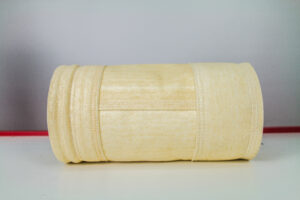
In real production environments, extruded PTFE sewing thread often leads to:
-
Mandatory reduction of sewing speed
-
Increased risk of:
-
Skipped stitches
-
Thread breaks
-
Unstable thread tension
-
-
Higher needle wear
-
Limited suitability for automated sewing lines
➡ As a result, extruded PTFE sewing thread is generally suitable only for low-speed or manual sewing, and not for modern industrial filter bag production.
2. Split-Film Process (Split-Film PTFE Sewing Thread)
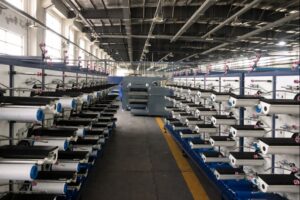
Process Principle
The split-film process follows a fundamentally different logic:
-
PTFE is first extruded into a highly uniform thin film
-
The film is mechanically split into numerous fine micro-filaments
-
Multiple micro-filaments are twisted together to form a true multifilament yarn
This process is closer to advanced industrial fiber manufacturing, rather than simple wire extrusion.
Structural Advantages of the Split-Film Process
Split-film PTFE sewing thread naturally offers:
-
✅ Highly uniform filament diameter
-
✅ True multifilament structure
-
✅ Soft, flexible thread body
-
✅ Excellent bending and recovery behavior
-
✅ Low surface friction
Performance in Filter Bag Manufacturing
In real filter bag sewing lines, split-film PTFE sewing thread allows:
-
Stable sewing speeds of 10–12 m/min or higher
-
Consistent stitch formation
-
Significantly reduced thread breakage
-
Smooth operation on automated sewing equipment
-
Superior resistance to long-term mechanical fatigue
Extrusion vs Split-Film — Technical Comparison
| Parameter | Extruded PTFE Thread | Split-Film PTFE Thread |
|---|---|---|
| Manufacturing method | Direct extrusion | Film splitting + twisting |
| Diameter uniformity | ❌ Poor | ✅ Excellent |
| Flexibility | ❌ Rigid | ✅ Optimally flexible |
| Surface friction | High | Low |
| Stitch stability | Prone to skips & breaks | Stable |
| Suitable sewing speed | ≤ 5 m/min | 10–12 m/min |
| Automation compatibility | Limited | Highly suitable |
| Long-term fatigue resistance | Moderate | Excellent |
| Breaking strength (1250D) | ≤ 35 N (typical max) | ≈ 55 N (average), higher peak values |
Engineering Conclusion
In modern industrial filter bag manufacturing:
The performance of PTFE sewing thread is fundamentally determined by the manufacturing process, not by the material name alone.
-
The extrusion process inherently results in:
-
Uneven diameter
-
Rigid structure
-
Limited high-speed sewing capability
-
-
The split-film process enables:
-
Uniform filament structure
-
Superior flexibility
-
Stable, high-speed, automated sewing performance
-
➡ This is why professional filter bag manufacturers consistently choose split-film PTFE sewing thread for demanding industrial applications.
Final Remarks
Selecting PTFE sewing thread is not a branding decision.
It is a decision based on process technology, structural behavior, and real production conditions.
Understanding the difference between extruded and split-film PTFE sewing thread helps filter bag manufacturers to:
-
Avoid premature seam failure
-
Increase production efficiency
-
Improve long-term filtration reliability
In industrial filtration, small details define long-term performance —
and sewing thread is one of those decisive details.