
Filter Bag Needle Hole Sealing Adhesive
Two-component silicone needle hole sealing adhesive that penetrates stitch holes and forms embedded seals for high-temperature filter bag applications.
Description
Filter Bag Needle Hole Sealing Adhesive Using Rapid Seal Silicone Technology
RapidSeal™ Silicone Needle Hole Sealing Technology,An industrially proven alternative to PTFE tape for all filter bags
Product Overview
RapidSeal™ is KABORY’s proprietary two-component, high-temperature silicone needle hole sealing technology, developed for industrial filter bag manufacturing and applied globally for over six years.
Unlike conventional PTFE tape, which provides only surface coverage, RapidSeal penetrates into stitch holes and cures into a columnar, embedded sealing structure, forming a true internal seal within the sewing line.
This embedded sealing approach improves sealing stability under high temperature, chemical exposure, and long-term pulse-jet cleaning conditions.
How Filter Bag Needle Hole Sealing Adhesive Eliminates Leakage
RapidSeal silicone flows into the needle holes created during sewing and solidifies after curing, forming a mechanically anchored seal inside each stitch hole.
This creates a dual sealing structure:
-
Surface sealing along the stitch line
-
Internal structural sealing inside each needle hole
By sealing leakage paths at their structural origin, Rapid Seal provides consistent sealing performance where surface-applied materials are limited.
Core Advantages of RapidSeal™ Needle Hole Sealing
-
-
Ultra-Fast Cure (5–8 seconds)
Designed for inline operation with automatic filter bag sewing machines, without adding an extra sealing station -
True Needle-Hole Sealing Mechanism
Silicone penetrates and fills stitch holes instead of masking them on the surface -
High-Temperature Stability
Suitable for continuous operation up to 250 °C -
Chemical Resistance
Resistant to acidic gases, moisture, and repeated thermal cycling -
Broad Filter Media Compatibility
PPS, Aramid (Nomex®), P84, Fiberglass, PTFE-laminated felts, and other industrial filter media
-
Industrial First
KABORY is the first company worldwide to research, industrialize, and mass-apply silicone-based needle-hole sealing as a replacement for PTFE tape in high-temperature filter bags.
RapidSeal delivers a safer, more reliable, and more economical sealing solution for modern bag house systems.
⚖️ RapidSeal vs PTFE Tape
| Comparison | PTFE Tape | RapidSeal Silicone Sealing |
| Sealing Mode | Surface coverage | Penetrates into stitch holes, forming columnar embedded seals |
| Material Compatibility | Polyester, Acrylic (partially effective) | Fully compatible with PPS, Aramid, P84, Fiberglass, PTFE laminated media |
| Temperature Resistance(Real) | ≤170 °C continuous | Stable at ≥250 °C continuous |
| Fatigue Resistance | Prone to peeling under pulse-jet cleaning | Withstands millions of cleaning cycles without loosening |
| Risk | Tape detachment may wrap into fans and cause damage | No surface detachment — safer and more reliable |
⚠️ The Hidden Risks of PTFE Tape in High-Temperature Filter Bags
-
Incomplete Needle-Hole Sealing
Surface coverage cannot block leakage paths inside stitch holes -
Large-Area Peeling
Pulse-jet cleaning and gas erosion cause progressive detachment -
Equipment Safety Risk
Detached tape has been reported to wrap into fans, leading to imbalance, entanglement, and motor failure -
Bag Wear & Premature Failure
Sharp tape edges can cut cuffs and accelerate fabric fatigue
Industry-Based Technical Explanation
Aramid (Nomex®) with PTFE Membrane
The industry-accepted process involves PTFE dipping prior to membrane lamination to increase surface energy and adhesion.
PTFE tape lacks this bonding layer, resulting in weak adhesion and frequent detachment under thermal cycling and pulse cleaning.
Fiberglass Filter Media
Fiberglass features a rough, brittle structure with low tolerance for surface-only bonding.
PTFE tape experiences uneven stress and full-strip detachment, whereas RapidSeal achieves stability through mechanical embedding + chemical crosslinking.
🧾 RapidSeal Silicone Compatibility with Filter Media
| Filter Media | Surface Characteristics | Adhesion Strength | Needle-Hole Penetration | Columnar Seal Formation | Application Notes |
| Polyester | Smooth, mild polarity | ⭐⭐⭐⭐ | ✅ Moderate | ✅ Achievable | Common in low–mid temp filtration; use medium-viscosity silicone |
| Acrylic | Dense fibers, moderate polarity | ⭐⭐⭐⭐ | ✅ Moderate | ✅ Easy | Stable bonding in 80–120 °C environments |
| Aramid | High polarity, consistent texture | ⭐⭐⭐⭐⭐ | ✅ Strong | ✅ Easy | Excellent adhesion and shear strength |
| PPS | Moderate surface energy, thermally stable | ⭐⭐⭐⭐☆ | ✅ Strong | ✅ Easy | High performance at elevated temps |
| P84 | Low surface energy | ⭐⭐⭐⭐☆ | ✅ Moderate | ✅ Achievable | ⚠ Surface roughening recommended for best bonding |
| Fiberglass | Rough, open weave | ⭐⭐⭐⭐☆ | ✅ Excellent | ✅ Very easy | High-temp compatibility; mechanical locking |
✅ Conclusion
PTFE tape has long been used as a quick sealing solution, but in Aramid, Fiberglass, and PTFE laminated felts, its limitations are severe: weak adhesion, detachment, equipment risk, and shortened bag life.
RapidSeal Silicone provides a proven, science-based upgrade: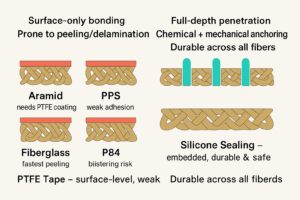
- Embedded columnar seals instead of surface-only coverage
- Reliable performance at high temperature and under pulse cleaning
- Zero consumable cost and reduced maintenance risk
- Verified in real-world industrial use for 6+ years with no failures
RapidSeal = Scientific innovation + Long-term stability + Safer, cleaner filtration.
Contact us today to request samples or technical support. See how RapidSeal can improve your baghouse efficiency and reliability.